 DeadNuts Digital
7 min read
Facebook Ads for Contractors: Do They Actually Work for Trade Businesses?
By Muhammad Furqan · Last updated · Published · Reviewed by Muhammad Furqan
Facebook ads for contractors work, but not the way most people expect. They don't replace a good reputation. They compress the time it takes a stranger to become a customer. This is a straight answer for plumbers, electricians and builders on whether Facebook ads are worth the money, or just another thing a marketing guy is trying to sell you. Facebook works best as one part of a wider plan, which is how we run lead generation for contractors.
Picture a typical scenario (illustrative): a plumber in a mid-sized Tennessee city spends six years building a name through word of mouth, then watches a competitor half his age fill a booking calendar from a $15-a-day Facebook campaign. That's usually the moment a contractor starts asking whether Facebook ads are worth the money.
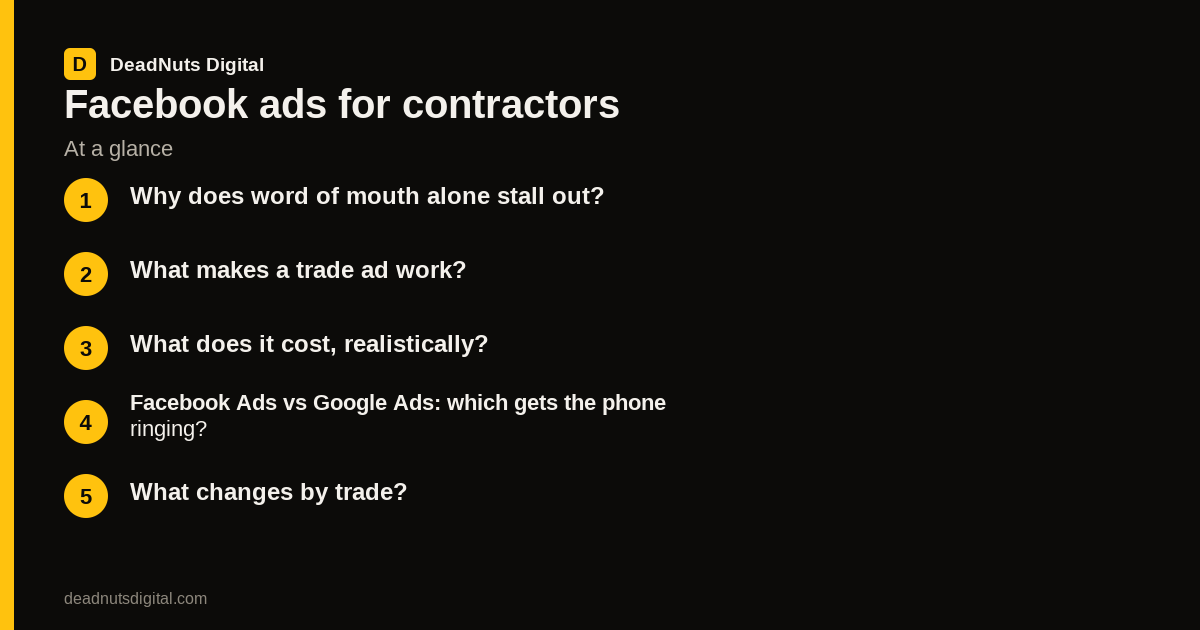
Why does word of mouth alone stall out?
Referrals are the best lead a contractor will ever get: someone else has already done the convincing. The problem is volume. A business relying only on referrals grows at the rate its existing customers talk, which is fine at two jobs a week and a bottleneck at ten.
Facebook ads don't compete with referrals; they fill the gap between them, putting the business in front of people who don't know anyone to ask.
What makes a trade ad work?
Three things separate a Facebook ad that books jobs from one that just burns budget:
- A specific, local trigger. "Need an electrician?" gets ignored. "Outlet sparking in your Knoxville rental?" gets a click, because it names the exact problem someone is dealing with right now.
- A face, not a logo. Trade ads with a real person in uniform consistently outperform stock photography or a business logo alone. People are hiring a person to come into their home, not a brand.
- A frictionless next step. A phone number, a short lead form, or a clear "book online", never a vague "learn more" that dumps someone on a homepage with no obvious action.
The full playbook for headlines, photos and calls to action is in our guide to Facebook ad creative and copy for trades.
What does it cost, realistically?
A common starting test is $10-$30 a day. That's not a rounding error in a marketing budget. It's the entire test. At that spend, a single well-targeted local ad can generate a handful of qualified inquiries a week for a low-ticket service like a clogged drain or a GFCI outlet install.
High-ticket work (remodels, solar installs, landscaping) needs a longer runway, because the ad's job shifts from "book me now" to "remember me when you're ready," and that takes repeated exposure. For ranges by ticket size and how to judge cost per lead, see how much a contractor should spend on Facebook ads.
Facebook Ads vs Google Ads: which gets the phone ringing?
This isn't a which-is-better question. It's a which-job-are-you-trying-to-do question, and the two platforms do different jobs.
| Item | Google Ads | Facebook Ads |
|---|---|---|
| What it does | Catches people already looking | Creates demand that wasn't being searched for yet |
| Typical buyer | Has a problem right now and is choosing between whoever shows up first | Hasn't thought about it yet, stops on an ad and considers it for the first time |
| Cost signal | High intent, and the cost per click reflects it, especially on competitive trade keywords in big metros | Better at planting the idea than catching the decision |
| Best for | Urgent, low-ticket service calls (clogged drains, no power, lockouts) | Considered, higher-ticket work (remodels, solar, landscaping) |
Google Ads catches people already looking. Someone searching "emergency plumber near me" has a problem right now and is choosing between whoever shows up first. Google Ads puts a business in front of that existing demand: high intent, but the cost per click reflects it.
Facebook ads create demand that wasn't being searched for yet. Nobody scrolls Facebook typing "solar installer near me," but plenty of homeowners will stop on an ad showing an estimated electric bill savings and think about it for the first time. Facebook is better at planting the idea; Google is better at catching the person who already has it.
The practical split for a trade business
Urgent, low-ticket service call work leans Google, because the buyer is already searching. Considered, higher-ticket work leans Facebook, because the ad's job is starting the conversation months before someone searches for an estimate. Most trade businesses with a real budget eventually run both: Facebook building the audience and Google catching the ones who've started actively looking. If you want the Google side handled, see our Google Ads service for trades.
One thing not to do
Whichever platform you use, set expectations by job size. A lead for urgent work should convert fast or not at all; a lead for a major job still needs nurture, even when it comes from a Google search. The click doesn't skip that step.
What changes by trade?
The same Facebook ad won't work for a plumber, an electrician and a solar installer, because the moment each one gets called is different.
Plumbers
Plumbers get called in a panic. The trigger is almost always something happening right now: a clogged drain, a burst pipe, no hot water. Ads that perform lead with the exact scenario ("water pooling under the sink?") and a phone number that's answered fast, because a plumbing ad that takes six hours to respond has already lost the job to whoever picks up first.
Electricians
Electricians sit in the middle. Some jobs are urgent (no power, a tripped breaker), but a lot of electrical work is planned: a rewire, an EV charger install, an electrical panel upgrade before selling a house. Ads should split by intent: urgent-fault creative for the emergency side, and consultation-style creative ("thinking about an EV charger?") for the planned side, run as separate campaigns rather than one ad trying to cover both. More in Facebook ads for electricians.
Solar installers
Solar installers are selling a considered, high-ticket purchase. Nobody clicks a solar ad and signs a contract the same day. The job of the ad is to start a conversation (an estimate, a consultation, a savings estimate), not to close a sale. Creative built around an estimated electric bill savings (for example, "cut your electric bill by an estimated $X a month") outperforms generic panels-on-a-roof imagery, because it makes the outcome concrete before the sales conversation even starts. Keep the claims honest: federal solar tax credit rules have changed, so don't lean on them in your ads. More in Facebook ads for solar installers.
Builders and landscapers
Builders and landscapers sell $20,000-$150,000 projects over weeks or months, so the ad's job is being remembered rather than booking on the spot. See Facebook ads for builders and landscapers.
What stays the same across every trade
A real contractor in the photo, one clear next step, and a headline that names the specific problem rather than the trade itself. "Need an electrician?" is a job title. "Outlet gone dead again?" is a problem someone is Googling right now.
Where Facebook ads don't work
Facebook ads won't fix a business that has no capacity to take on new jobs, a website that takes eight seconds to load, or a service area so broad the targeting can't narrow down to people who'll actually convert. Running ads into those problems just makes them more expensive. Fix the operational side first; the ad account isn't a substitute for it.
If ads are running but not producing, work through the five signs a Facebook campaign is underperforming or our guide on why trade ads aren't converting.
How to know if you're ready
A trade business is ready to test Facebook ads when it can answer yes to three things:
- There's spare capacity to take on 3-5 extra jobs a month.
- There's a way to capture a lead without a missed call turning into a lost job.
- Someone can commit to checking the ad account at least twice a week for the first month.
Skip any of those and the ad spend is working against an unfinished setup rather than a real opportunity.
Note: Book a free 30-minute audit with DeadNuts Digital. We'll tell you honestly whether your business is ready to run ads, and what a realistic first campaign looks like, before you spend a dollar. Book your free audit