 DeadNuts Digital
5 min read
Local SEO for Contractors: The Map Pack Ranking Factors Checklist
By Muhammad Furqan · Last updated · Published · Reviewed by Muhammad Furqan
This guide to local SEO ranking factors for contractors explains the ranking mechanics: how Google decides who wins the map pack in your cities, and which levers you can actually pull. Most contractor work is local: the customer wants someone who services their city and can get there. Americans mostly search a city name plus the service, or 'near me', rarely a ZIP code. Local SEO is how you become the obvious choice in your service area, city by city. New to SEO? Start with the step-by-step guide on how to do your own SEO, or see our SEO service if you'd rather have it done for you.
Local SEO is the part of search that decides who shows up for 'near me' and '[trade] [city]' searches, the ones that actually turn into jobs. It's a bit different from broad SEO: instead of chasing one big national keyword, you're winning dozens of small, high-intent local searches across the cities you service. For a trade business, that's where the money is, and it's very winnable.
Note: Rather have someone do all this for you? Our local SEO for contractors service handles your Google Business Profile, reviews, citations and city pages from $997 a month, month-to-month. The checklist below is the same work, if you'd rather do it yourself.
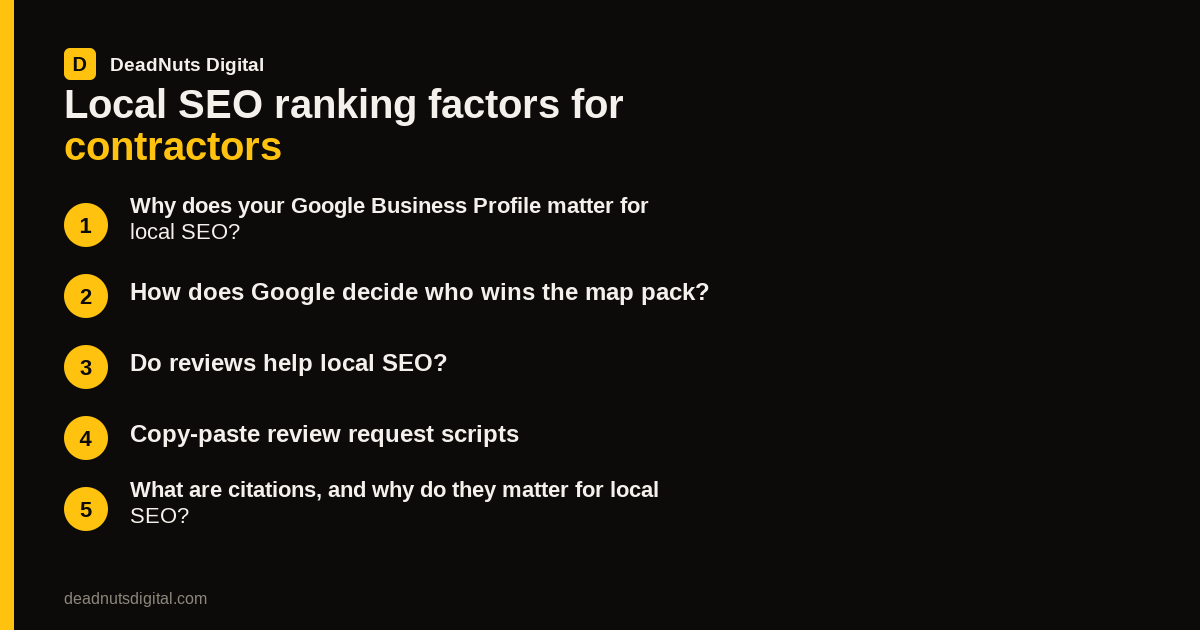
Why does your Google Business Profile matter for local SEO?
Your Google Business Profile (GBP, formerly Google My Business) is the engine of local SEO. It's what puts you in the map pack, shows your reviews, and lets someone call or find you in one tap. A half-finished profile is the most common reason a good contractor stays invisible. Get this right before anything else.
- Fill in every field: primary category, all services, service area, hours, phone, website.
- Add real photos of your team, trucks and finished jobs, and keep adding them.
- Write a clear description of what you do and where you work.
- Turn on messaging and keep your hours accurate so you don't miss inquiries.
Note: A fully optimized Google Business Profile is the fastest local-SEO win a contractor can make. Here's how we set trades up to rank. See our SEO for contractors service
How does Google decide who wins the map pack?
Google ranks the local pack on three things, and once you understand them, the work makes sense: relevance (does your profile match what they searched?), distance (how close are you to the searcher?), and prominence (how established and well-reviewed are you?). You can't move your shop, but you absolutely can improve relevance and prominence, and that's most of the game. If you're a service-area business, Google lets you hide your street address and list the area you serve, generally no more than about two hours' drive from your base. A virtual office or mailbox isn't eligible unless it's staffed.
- Relevance: list every service and use the right categories so you match more searches.
- Prominence: build reviews, citations and a real website to look established.
- Distance: you can't change it, but useful city pages help you show up in organic results across your whole service area, not just next door.
 Watch: How to improve your local ranking on Google
Google's own explainer on how local ranking works: relevance, distance and prominence, the exact three factors above.
What the ranking factor research says
Google doesn't publish weightings. The closest thing is Whitespark's 2026 Local Search Ranking Factors survey, where 47 local search experts scored 187 factors. Higher score means experts think it matters more. It's expert opinion, not Google data, but it lines up with relevance, distance and prominence.
| Factor (map pack) | Expert score | What it means for a contractor |
|---|---|---|
| Primary Google Business Profile category | 227 | Pick the category that matches your main money job: "Plumber," "Electrician," "Roofing contractor." |
| Proximity of address to the searcher | 225 | You can't move. City pages and reviews help you reach further. |
| Keywords in the business name | 223 | Use your real, legal or trading name only. Google's guidelines ban stuffing keywords into the name, and profiles get suspended for it. |
| Physical address in the city searched | 213 | Explains why you rank best near your base. Never use a fake or virtual address to fake it. |
| Business open at the time of search | 189 | Keep hours accurate. If you answer 24/7, say so. |
| High Google rating (4 to 5 stars) | 181 | Ask every happy customer. A steady flow lifts the average. |
| Number of Google reviews with text | 170 | Ask customers to mention the job and the city. |
| Recency of reviews | 164 | New reviews every month beat a big batch from two years ago. |
For organic results under the map, the top-scored factor was a dedicated page for each service. That's why one page listing 20 services rarely ranks for any of them.
Do reviews help local SEO?
Nothing lifts a local ranking (and a close rate) like a steady stream of genuine reviews. They tell Google you're a real, active, trusted business, and they tell the next customer you're the safe choice. BrightLocal's 2026 Local Consumer Review Survey (1,002 US adults) found 74% of people look for reviews from the last three months and 47% won't use a business with fewer than 20 reviews. The contractors who win their city almost always have more, fresher reviews, and it's usually because they simply ask, every job. Never buy, fake or gate reviews: the FTC's Consumer Review Rule bans it.
- Ask every satisfied customer, in person and with a follow-up text link.
- Make it one tap. The harder it is, the fewer you'll get.
- Reply to all of them. It shows Google and customers you're responsive.
- Keep them coming. Freshness counts more than a big old batch.
Copy-paste review request scripts
Most contractors don't get reviews because they don't ask, or ask badly. Use these as they are or tweak them to sound like you. Ask every customer, not only the ones you think are happy, and never offer a discount or gift in exchange for a review.
In person, as you pack up
"Glad we got that taken care of today. Most of our work comes from people finding us on Google, so a quick review really helps a small business like ours. I'll text you the link now. It takes about a minute."
Text message, same day
"Hi [Name], thanks for having us out to [job] today. If you have a minute, would you leave us a quick Google review? It helps neighbors find a contractor they can trust: [review link]. Thanks, [Your name], [Business]."
Follow-up, three days later
"Hi [Name], just checking everything is still working well after the [job]. If you get a chance, a short review would mean a lot: [review link]. And if anything isn't right, reply here and we'll fix it."
Replying to a bad review
"[Name], thanks for the feedback, and I'm sorry the [issue] wasn't what you expected. That's not the standard we hold ourselves to. Please call me directly at [number] so I can make it right."
Keep replies short, calm and specific. Future customers read your replies as closely as the reviews.
What are citations, and why do they matter for local SEO?
A citation is any online mention of your business name, address and phone number: on directories, your website, social profiles and industry listings. In the US, the ones to get right are Google Business Profile, Bing Places, Apple Business Connect, Yelp, the Better Business Bureau, Nextdoor and Angi, plus the main data aggregators that feed smaller directories. When these all match exactly, it's easier for search engines to trust your details. When they're inconsistent (old numbers, different address formats), it creates doubt and can hold you back. Cleaning them up is unglamorous but worth doing.
How do city pages help you rank across your whole service area?
Your Google Business Profile ranks you strongest near your base. To show up across every city you service, you need genuinely useful city pages on your site: real content about the work you do in each area, local projects, photos and reviews, not the same page with the city name swapped. Google's spam policies treat mass-produced doorway pages as abuse, so build fewer, better pages for places you actually serve. Do that and you can appear for '[trade] [city]' across your whole service area, which is where a huge amount of local trade work hides.
Note: We build lead generation around the exact cities you service, so every inquiry is a job you can actually get to. How our lead generation works
You don't need to beat every contractor in the metro. You need to be the obvious choice in the cities you actually service.
Schema markup for contractor websites
Schema is code on your site that tells search engines, in plain data, what your business is, where it works and how to reach it. Use the most specific schema.org type for your trade:
| Trade | Schema.org type |
|---|---|
| Plumbing | Plumber |
| Electrical | Electrician |
| Roofing | RoofingContractor |
| Heating and cooling | HVACBusiness |
| Remodeling and building | GeneralContractor |
| Painting | HousePainter |
| Locksmith | Locksmith |
| Other home services | HomeAndConstructionBusiness |
Fill in name, phone, URL, address (or areaServed if you hide your address), opening hours and sameAs links to your Google, Yelp and BBB profiles, and make every detail match your Business Profile exactly. Two honest limits: Google won't show review stars for reviews a business marks up about itself, and since 2023 FAQ rich results only show for well-known government and health sites. Mark up FAQs if you like, but don't expect stars or dropdowns in results. Check your work with Google's Rich Results Test.
Local SEO and AI search (AI Overviews, ChatGPT)
Homeowners now ask AI tools for contractors as well as Google. Scorpion's 2026 research found 22% of homeowners use AI to research providers, and BrightLocal's 2026 survey found 45% of consumers use AI tools for local recommendations. The good news: the same work that wins the map pack feeds these answers.
- Be consistent everywhere. AI tools cross-check your name, services and cities across your site, Google, Yelp, the BBB and directories. Mismatches make you a riskier answer.
- Answer real questions on your pages. "How much does a water heater replacement cost in [city]?" answered plainly, near the top, is the kind of text AI tools quote.
- Get reviews that say what you did and where. "Replaced our panel in [city], clean and on time" tells both people and machines what you're known for.
- Keep one page per service and per real city. Clear, specific pages are easier to understand and cite than one catch-all page.
A seasonal Google Business Profile post calendar
Posts and fresh photos keep your profile active. Time them to what people search each season:
| Season | HVAC | Plumbing | Roofing | Electrical |
|---|---|---|---|---|
| Spring | AC tune-ups before the heat | Sump pumps, outdoor spigots | Storm and wind damage checks | Outdoor lighting, EV chargers |
| Summer | AC repair, no-cool calls | Water heater and irrigation leaks | Hail damage, replacements | Panel upgrades, surge protection |
| Fall | Furnace safety checks | Winterizing pipes | Replacements before winter | Standby generators |
| Winter | No-heat emergencies | Frozen and burst pipes | Ice dams, leaks | Heating circuits, holiday lighting |
How to measure local SEO results
| Metric | Where to find it | What it tells you |
|---|---|---|
| Calls, website clicks and direction requests | Google Business Profile performance | Whether the map pack is turning into contact |
| Searches that showed your profile | Google Business Profile performance | Which services and terms you're visible for |
| Clicks and queries for service and city pages | Google Search Console | Whether organic rankings are growing outside your base |
| Map rankings across your service area | A grid rank tracking tool | How far your visibility reaches from your base |
| Booked jobs from organic and map | Call tracking plus your job software | The only number that pays the bills |
Run a 15-minute competitor gap check
- Search your main service plus your city on your phone and note the three map pack winners.
- Compare their primary category, number of reviews, how recent the newest one is, and how many photos they have.
- Open their websites. Do they have a page for each service and each city you want?
- Write down every gap. That list is your next three months of work.
What local SEO costs: budget tiers
| Option | Typical cost | What you get |
|---|---|---|
| Do it yourself | $0 plus a few hours a week | Google Business Profile is free. You supply the time and consistency. |
| Freelancer | $1,150 a month on average | Usually profile and citation work, sometimes content |
| Agency | $1,819 a month on average | A wider scope and a team, scope varies a lot |
| DeadNuts Digital Foundation | $997 a month, month-to-month | Google Business Profile optimization, local SEO, technical SEO and schema, a review engine and a monthly report |
Freelancer and agency averages come from an Ahrefs survey of 439 SEO providers (updated August 2024). Our Growth ($1,997) and Scale ($2,997+) retainers add more; see contractor marketing services for what each tier includes. Foundation is where our done-for-you local SEO starts.
Or skip the grind and get exclusive local leads
Local SEO is a compounding, ongoing job, and you've got jobs to run. The shortcut is to have exclusive, never-shared leads for your area sent straight to you while your local presence builds. Marketplace leads can go to you and other pros, so you end up competing on price; exclusive local leads are yours alone, with a higher close rate and no race to the bottom.
Note: Want local jobs now, not in three months? Get exclusive, never-shared leads for your cities. Get exclusive local leads
The local-SEO checklist for contractors
- This week: fully complete and optimize your Google Business Profile.
- This week: start a simple review-request habit on every finished job.
- This month: fix inconsistent name, address and phone listings across Google, Bing, Apple, Yelp and the BBB.
- This month: build useful city and service pages for the areas you actually serve.
- If you need work now: run ads or buy exclusive local leads while it builds.
Local SEO ranking factors: where DeadNuts Digital fits
We handle local SEO for home service contractors end to end: Google Business Profile, the map pack, reviews, citations and city pages, so you become the go-to name in your area. And when you need work faster than local SEO can build it, we send exclusive, never-shared leads straight to you. Month-to-month, no lock-in. The free audit shows you exactly where you're winning and losing local search right now.
Local SEO ranking factors: sources and references
- Google: Improve your local ranking on Google
- Google Business Profile (official)
- Whitespark: Local Search Ranking Factors 2026
- Google: Guidelines for representing your business on Google
- brightlocal.com (2026 review survey)
- prnewswire.com (Scorpion 2026 report)
- FTC: Consumer Review Rule
- Google Search Central: Local business structured data
- Google Search Central: Changes to HowTo and FAQ rich results (2023)
- Ahrefs: SEO Pricing, 439 People Polled